Baseball Card Size & Dimensions: 2.5 x 3.5 in, mm, cm, Every pt
A baseball card is 2.5 x 3.5 inches (63.5 x 88.9 mm). Here are the conversions in mm and cm, what pt means, vintage and mini exceptions, and which holders fit.
What This Guide Recommends
The picks referenced below, at a glance — our verdict, current availability, and who each one suits.

Slab owners protecting the holder itself

Displaying and protecting premium raw cards

Grading submissions and serious shipping

Every collector’s first supply purchase
Slab owners protecting the holder itself
Displaying and protecting premium raw cards
Grading submissions and serious shipping
Every collector’s first supply purchase
Short answer: a standard baseball card is 2.5 inches wide by 3.5 inches tall — that is 63.5 mm × 88.9 mm, or 6.35 cm × 8.89 cm. Topps set that size in 1957 and nearly every card made since has kept it. The regular toploader built for it measures 3″ × 4″ on the outside and is rated 35pt for thickness.
The One Measurement Every Collector Should Know
That one figure is the one to memorize, because it is the reason a single kind of penny sleeve, a single toploader and a single 9-pocket binder page protect nearly your whole collection. The entire modern hobby — Topps, Bowman, Panini, flagship, Chrome, inserts, most parallels — has run on 2.5 × 3.5 ever since Topps locked it in, so if a card left a pack after the late 1950s, assume it is standard-sized.
But “how big is a baseball card” has more to it than one figure: there is the card’s footprint (width and height), its thickness (measured in points), and a handful of vintage and oddball exceptions that do not follow the standard. Get all three right and you will never buy the wrong supplies again — which is really what this question is usually about. If you are just getting oriented in the hobby, read this alongside how to read a baseball card and the beginner’s guide to collecting.
The Standard Size, in Every Unit
The standard modern trading-card size, spelled out in the units people actually search for:
- Inches: 2.5 in × 3.5 in (2-1/2″ × 3-1/2″)
- Millimeters: 63.5 mm × 88.9 mm
- Centimeters: 6.35 cm × 8.89 cm
If you are buying supplies internationally and see pages or sleeves listed around 64 × 89 mm, that is the correct standard size — manufacturers just round. This footprint applies whether the card is paper (flagship) or chromium (Chrome/refractor); the Chrome-versus-paper difference changes the finish and the thickness slightly, not the width and height.
Thickness: What “Points” (pt) Actually Mean
Here is the part that trips up new collectors. When a toploader or magnetic holder is sold as “35pt” or “130pt,” that number is thickness, not footprint — and it is describing the capacity of the holder, not usually the card itself.
A point (pt) equals one one-thousandth of an inch (0.001″). A standard base card is thin, so it slides comfortably into a 35pt holder — which is exactly why 35pt is the default size for regular toploaders and one-touch magnetics. As cards get thicker, the point number you need climbs:
| Card type | Typical holder you need |
|---|---|
| Standard base / Chrome / insert | 35pt |
| Jersey / relic (single swatch) | 55pt – 75pt |
| Patch / dual-relic / thick memorabilia | 100pt – 130pt |
| Booklet / super-thick manufactured cards | 180pt+ |
The rule is simple: match the holder’s point rating to the card, and when in doubt, size up. A slightly loose fit is harmless; a card jammed into a too-small holder can pick up dinged edges — the exact kind of damage that costs you a grade. (For why edges and corners matter so much, see how grading works.) A 3” x 4” toploader-and-penny-sleeve bundle is the cheap, bulk workhorse for everything you keep; a 35pt UV ONE-TOUCH magnetic holder is the display-grade home for the handful of cards you actually care about.
Points in Inches and Millimeters
Because a point is a fixed unit — 0.001″, and 0.001″ is exactly 0.0254 mm — every holder rating converts cleanly. Useful if you buy supplies outside the US, where thickness is quoted in millimeters:
| Holder rating | Inches | Millimeters |
|---|---|---|
| 35pt | 0.035″ | 0.89 mm |
| 55pt | 0.055″ | 1.40 mm |
| 75pt | 0.075″ | 1.91 mm |
| 100pt | 0.100″ | 2.54 mm |
| 130pt | 0.130″ | 3.30 mm |
| 180pt | 0.180″ | 4.57 mm |
| 260pt | 0.260″ | 6.60 mm |
Remember which side of the fit the number describes: it is the capacity of the holder, not the measured thickness of the card. You want the rating at or a little above the card, never below.
Holder Footprints: The Other Number on the Package
Card supplies carry two numbers, and confusing them is the single most common supply-buying mistake. One is the footprint — the outside width and height of the holder. The other is the point rating — how thick a card it swallows. A package reading “3″ × 4″, 35pt” is telling you both: a holder three inches by four inches on the outside, with 0.035″ of room inside.
That 3″ × 4″ figure is not the card’s size, and it is not a mistake. Set it against the 2.5″ × 3.5″ card and the arithmetic explains itself:
- Width: 3″ − 2.5″ = 0.5″ of slack, i.e. a quarter inch on each side
- Height: 4″ − 3.5″ = 0.5″ of slack, again a quarter inch top and bottom
That quarter inch is exactly the room a penny sleeve needs — which is why the correct order is always card → sleeve → toploader, and why a sleeved card still drops into a 3″ × 4″ holder without force.
| Supply | Footprint | What it’s for |
|---|---|---|
| Penny sleeve (soft) | Card-sized, ~2.5″ × 3.5″ | The first layer under everything — one raw card, nothing beneath it |
| Regular toploader | 3″ × 4″ | Everyday keeping, shipping and trading; takes a sleeved card |
| Rigid hard sleeve | 3″ × 4″ | The same job as a toploader, with stiffer walls |
| One-touch magnetic | Larger than 3″ × 4″, rated in points | Display and long-term keepers; match the rating to the card |
| Semi-rigid holder | Card-sized, flexible walls | Grading submissions only |
| 9-pocket binder page | Pockets sized to the card | Set-building and player runs — 9 sleeved cards a side |
The one entry worth memorizing is the last-but-one. Toploaders and semi-rigids take the same 2.5″ × 3.5″ card, so collectors assume they are interchangeable — they are not. Every major grader asks for submissions in semi-rigid holders, not toploaders, because a semi-rigid flexes enough to release the card without a tool near its corners. If a card might ever be submitted, a pack of semi-rigid holders sized for PSA, SGC, BGS and CGC is the holder it belongs in from the moment it leaves the pack. Everything else in your collection is toploader territory.
Vintage and Oddball Sizes (the Exceptions)
Not everything is 2.5 × 3.5. The main exceptions, roughly oldest to newest:
- Tobacco-era cards (T206 and friends, ~1909–1915): noticeably smaller than standard — roughly 1½″ × 2⅝″. These do not fit modern sleeves; they need tobacco-sized holders.
- 1952 Topps and other early-1950s issues: slightly larger than today’s card, about 2⅝″ × 3¾″. This is why a ‘52 Mantle looks oversized next to a modern card and won’t sit flush in a standard 9-pocket page.
- Post-1957 standard: Topps settled on 2.5 × 3.5, and the hobby standardized around it. Nearly everything from the late 1950s forward is this size.
- Mini cards (Allen & Ginter and similar): deliberately small, echoing the old tobacco format. They rattle in a standard sleeve and need mini-sized sleeves and toploaders.
- Box-toppers, oversized and 5×7 cards: premium jumbo cards issued as pack or box hits — far too big for standard supplies, and usually housed in oversized toploaders or team bags.
The takeaway: if a card is modern, assume it is standard-sized. If it is pre-war, a mini, or an oversized insert, measure before you buy supplies. Our parallels and refractors reference covers the finishes you’ll meet on modern cards; sizing is the other half of knowing what a card needs.
Matching Supplies to Size and Thickness
This is where dimensions become practical. A clean protection stack for a standard modern card, cheapest to most protective:
- Penny sleeve first, always. A soft standard 100-count sleeve is the first layer under everything else. It is the difference between a card that stays mint and one that gets micro-scratched. Buy these in bulk — you will use hundreds.
- Toploader for anything you’re keeping or shipping. A 3” x 4” toploader-and-sleeve bundle (sleeve the card first) protects corners and edges and is the hobby standard for mailing. Size up in points for thick relics and patches; rigid hard sleeves do the same job in the same 3” x 4” footprint.
- One-touch magnetic for the keepers. A 35pt UV ONE-TOUCH magnetic holder is the display-grade holder for your best raw cards — UV protection, screw-free magnetic closure, and it looks the part on a shelf. Match the point rating to the card, exactly as with toploaders.
- Semi-rigid holders if grading is on the roadmap. Anything you might submit goes into a semi-rigid holder rather than a toploader — same card size, different stiffness, and the one graders actually ask for.
- Binder pages for sets and player runs. Standard cards fit 9-pocket pages; a dedicated card binder keeps a base set or a player collection organized and browsable.
- A storage box for the bulk. Everything that isn’t in a binder or on display lives in a stackable storage box built for toploaders.
For the full protection workflow — humidity, sunlight, long-term storage — see how to store and protect your cards. Get the sizes right first, and every supply purchase after that is easy.
The Short Version
- Standard baseball card size: 2.5″ × 3.5″ (63.5 × 88.9 mm / 6.35 × 8.89 cm), standardized by Topps in 1957.
- Thickness is measured in points (pt), 1 pt = 0.001″ = 0.0254 mm. Standard cards fit 35pt (0.89 mm) holders; relics and patches need 55pt–130pt+ (1.40–3.30 mm).
- A regular toploader’s footprint is 3″ × 4″ — a quarter inch of clearance on every side of the card, which is exactly the room a penny sleeve takes. Footprint and point rating are two different numbers on the same package.
- Grading submissions go in semi-rigid holders, not toploaders — same card size, different stiffness, and the one every major grader asks for.
- Exceptions: vintage tobacco cards are smaller, early-1950s cards are larger, minis are small, and box-toppers are oversized — all need their own supplies.
- Protection stack: penny sleeve → toploader (or one-touch for keepers) → binder page or storage box.
Recommended Products for This Guide
![Ultra Pro Card Supplies PSA Graded Standard Card Sleeves [100 Count]](https://m.media-amazon.com/images/I/51-CRcTjXvL._SL320_.jpg)
Ultra Pro Card Supplies PSA Graded Standard Card Sleeves [100 Count]
Amazon →

Ultra PRO - 35pt Cards UV ONE-TOUCH Magnetic Holder - Premium Trading Card Display Case, Magnetic Closure, Standard Size Card Protector
Amazon →

Semi Rigid Card Holders & Sleeves for PSA, CGC, BGS & TAG Trading Card Grading Submission
Amazon →
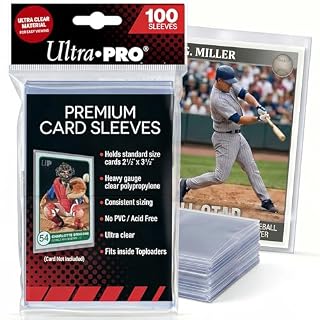
Ultra Pro Premium Clear Card Sleeves, 2.5" x 3.5", 100 Pack | Soft acid-free, non-PVC polypropylene sleeves protect standard Pokémon, MTG, baseball and football cards.
Amazon →

Card Sleeves Hard Plastic, Arjiekwei 3"X 4" Trading Card Holder, 35PT | Baseball Cards Protectors for Sports Football Game Cards (200 Hard Sleeves + 200 Soft Sleeves)
Amazon →
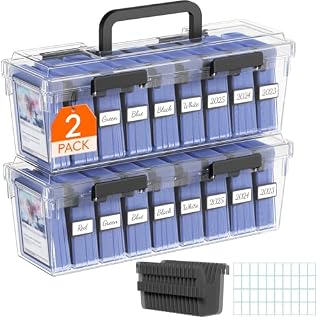
Lifewit Trading Card Storage Box with Handle, Fit for Toploader, 2 Pcs | Stackable Reinforced Latch Case with 8 Adjustable Dividers, Writable Labels, Organizer for MTG TCG Sports Baseball Bulk Cards
Amazon →

990 Pocket Baseball Card Binder Trading Card Collection Binder for MTG Game | Double Sided Pocket Sports Card Binder with 55 Removable Sleeves for TCG Game Card
Amazon →