How to Get Baseball Cards Graded: PSA vs BGS vs SGC (2026 Guide)
A complete walkthrough of grading baseball cards — how PSA, BGS, and SGC compare, where to read what grading actually costs, which cards are worth submitting, and how to prep a submission without wrecking your cards.
Shortcut: if the submission math does not clear, buying it already slabbed is the cheaper route — our rookie roundup ranks the graded ones worth owning.
Best Rookie Cards to Invest In (2026) →Before You Pay to Grade Anything
Two checks that decide it, in about a minute — then read the full walkthrough below.
Most submissions lose money. Enter your card's raw price, what a 10 sells for, and your honest odds of one — the calculator returns the expected profit and the break-even before you spend a cent.
Run the grading ROI calculatorIf the math doesn't clear, buying the slab beats making one. These are live eBay listings, so the prices are the real market — check what a graded copy of your card actually sells for.
The cards this guide talks about
- 2018 Topps #700 Shohei Ohtani rookie, PSA 10 See listings
- 2009 Bowman Sterling Mike Trout prospect auto, BGS 10 See listings
- 2024 Bowman Draft Roman Anthony, PSA 10 See listings
- Paul Skenes Bowman Chrome auto, PSA 10 See listings
- Bobby Witt Jr. Topps flagship rookie, PSA 10 See listings
- Jackson Chourio Topps flagship rookie, PSA 10 See listings
Why Grading Changes Everything
Slip the same card into a PSA 10 holder and it can sell for five, ten, sometimes fifty times its raw price. Grading does three things at once: it authenticates the card as genuine, it locks in a condition opinion from a trusted third party, and it standardizes the card into an asset that trades sight-unseen around the world.
That last part is the magic. A raw card is a negotiation; a graded card is a commodity. When you browse PSA-graded cards under $100, you’re seeing that liquidity in action — buyers pay confidently because the slab removes doubt.
But grading is not free money. Most cards people submit lose money after fees. This guide is about knowing the difference before you pay for it. And when the math says don’t submit, buying a card that is already slabbed is the cheaper route — our best rookie cards to invest in roundup ranks the graded ones worth owning outright.
The Big Three Grading Companies
PSA (Professional Sports Authenticator)
The market leader since the early 1990s, and the slab that moves the market. For modern baseball — a Shohei Ohtani rookie, a Paul Skenes Bowman Chrome auto — PSA 10s consistently bring the strongest prices, often dramatically more than competitors’ top grades. The PSA Set Registry also creates buyer demand that other services can’t match.
Choose PSA when: resale value is the priority, the card is modern, or you’re building registry sets.
SGC (Sportscard Guaranty Company)
The vintage specialist. SGC’s tuxedo-style black-core slab is iconic for pre-war and mid-century cardboard — a 1933 Goudey Babe Ruth looks right in an SGC holder, and serious vintage buyers respect the grade fully. SGC’s turnaround times are routinely the fastest of the big three and pricing tends to be friendlier.
Choose SGC when: grading vintage (especially pre-1970s), or when speed and cost matter and the card’s market doesn’t demand a PSA slab specifically.
BGS (Beckett Grading Services)
The detail nerd’s service. BGS issues four subgrades — centering, corners, edges, surface — alongside the overall grade, so you know exactly why a card got its number. The legendary BGS 10 Pristine and Black Label (all four subgrades 10) routinely out-sell PSA 10s. The catch: a standard BGS 9.5 Gem Mint usually sells below a PSA 10, and BGS’s gold-standard reputation is strongest in the modern/gaming era, less so for vintage.
Choose BGS when: you have a truly flawless modern card chasing the Black Label premium, or you want subgrade transparency.
The Grading Scale, Honestly Explained
All three services grade on a 1–10 scale, but the top of that scale does not mean the same thing at all three. The ladder below is PSA’s and SGC’s, where 10 is Gem Mint and the grade the market pays for:
| Grade | What it means for value |
|---|---|
| 10 (Gem Mint) | The money grade. Often several times a 9’s price on modern cards |
| 9 (Mint) | Solid for vintage; on modern cards, often barely above raw |
| 8 (NM-MT) | The “investment grade” floor for vintage; weak for modern |
| 7 and below | Vintage only. Modern cards graded ≤7 usually lose money |
| Authentic (no grade) | Confirmed genuine, but no condition grade assigned |
BGS is offset by half a grade at the top, and it trips people up constantly. At Beckett, 9.5 is Gem Mint and 10 is Pristine — so a BGS 9.5 is the equivalent tier to a PSA 10, not a near-miss, while a BGS 10 (and the Black Label, all four subgrades 10) sits above anything PSA issues. Keep the two questions separate: on condition, a BGS 9.5 is the target tier, not a near-miss; on price, the market still pays more for a PSA 10 than for a standard BGS 9.5 (see the BGS section above). Confusing the grade tier with the market premium is what leads sellers to price a 9.5 as though it were a PSA 9.
The brutal modern-card math: print runs are huge and condition is generally good, so only the top grade carries a real premium. Vintage flips this — a 1952 Mantle holds its value all the way down to a PSA 3, because survival itself is the scarce thing, not condition. Browse our Top 15 Vintage Baseball Cards and notice how low-grade copies still command serious money.
Should You Grade That Card? The Decision Framework
Run every candidate through four questions:
- What does it sell for raw? Check eBay sold listings, not asking prices.
- What does it sell for in the grade you realistically expect? Be pessimistic. Pack-fresh ≠ Gem Mint. If you can’t tell a 9 from a 10, assume 9.
- Is (graded price − raw price) at least 3x your all-in grading cost? All-in means fees + shipping both ways + supplies — our grading cost guide links each service’s current price page and itemises what the sticker fee leaves out, because we won’t print a fee that goes stale. Our grading ROI calculator runs this exact math for you — plug in the raw value, the grade you realistically expect, and your service tier, and it tells you whether the submission clears.
- Does the card need authentication? Vintage stars, autographs, and anything frequently faked get slabbed partly for the authentication alone — the math can tolerate thinner margins. (If counterfeits are your worry, our guide to spotting fake cards and slabs shows how to verify a card — and a graded holder — before you buy.)
If a card fails all four, keep it raw in a Ultra PRO - 35pt Cards UV ONE-TOUCH Magnetic Holder - Premium… and enjoy it. Slabs aren’t the only respectful way to store a card.
What’s actually worth submitting in 2026
- Flagship rookies of breakout stars in genuinely flawless condition — think Bobby Witt Jr., Jackson Chourio, Paul Skenes
- Bowman Chrome 1st autos of top prospects (why these dominate)
- Vintage Hall of Famers in any honest grade — Ruth, Mantle, Aaron, Clemente
- Key parallels and short prints from flagship sets (see our 2025 Topps Series 1 review for which inserts matter)
How to Prep a Submission (Without Damaging Your Cards)
More cards are ruined in preparation than people admit. The standard kit:
- Penny sleeve first. Slide the card in gently — never force it. Quality sleeves are the cheapest insurance in the hobby.
- Then a semi-rigid holder — not a toploader. Every major grader requests semi-rigids (Card Savers) because they’re easier to extract cards from. Pick up a 100-pack of semi-rigid Card Savers if you plan to submit regularly — any reputable brand sized for standard cards works.
- Don’t clean, wipe, or press the card. Surface alteration is detectable and gets cards rejected.
- Photograph everything before shipping, sandwich the stack between cardboard, and ship with tracking and insurance.
- Declare value honestly — it sets your service tier and the insurance coverage if something goes wrong.
What Graded Cards Look Like as Purchases
If the submission math doesn’t work for your cards, the other side of the trade is often smarter: buying already-graded cards lets someone else eat the grading fees. A 2018 Topps Baseball #700 Shohei Ohtani Rookie Card Graded PSA… or a Topps 2009 Bowman Sterling Prospects Mike Trout Auto Bgs 10 Rc… costs exactly what the market says it’s worth — no grading lottery involved. For newer money, a PSA 10 Roman Anthony Bowman Draft rookie shows how prospect slabs trade.
Our list of the best PSA-graded cards under $100 is a good starting point for slab buying on a budget.
Common Grading Mistakes to Avoid
- Grading bulk modern base cards. A common base rookie in PSA 9 is often worth less than the grading fee. Volume ≠ value.
- Submitting off-center cards hoping for a 10. Centering is measurable; graders measure it — so measure it yourself first and don’t burn a submission slot on a card the front border already disqualifies.
- Ignoring the back. Back centering and back surface kill more gem grades than fronts do.
- Chasing grading “specials” with unworthy cards. A discount on a bad bet is still a bad bet.
- Cracking and resubmitting endlessly. The “crack-and-resub” game has real costs and the population reports remember.
The Bottom Line
Grade when the math works or the card needs authentication. Use PSA for modern resale value, SGC for vintage and speed, BGS for subgrade transparency and Black Label dreams. Prep submissions properly with semi-rigid Card Savers, and when the math doesn’t work — buy the slab instead of making one.
New to the hobby entirely? Start with our Beginner’s Guide to Collecting Baseball Cards, then come back when you pull something special.
WHAT TO BUY AFTER THIS GUIDE
Best Rookie Cards to Invest In (2026)
Our top picks for baseball rookie cards worth investing in — the best rookie cards from the 2024 and 2025 classes, blue-chip graded rookies, and prospect boxes with the highest upside.
Supplies and Slabs Mentioned Above
Submission supplies and graded examples referenced in this guide — our verdict, current availability, and who each one suits.

Blue-chip modern card investing

Growth-stage rookie investing

Displaying and protecting premium raw cards

Protecting your collection
Blue-chip modern card investing
Growth-stage rookie investing
Displaying and protecting premium raw cards
Protecting your collection
Shop these on eBay
Graded singles and slabs trade on eBay, not Amazon — these open live listings so you can check real sale prices before you decide to buy a slab or grade your own.
Recommended Products for This Guide

2018 Topps Baseball #700 Shohei Ohtani Rookie Card Graded PSA 10 Gem Mint
Amazon →

Roman Anthony 2024 Bowman Draft Baseball Rookie Card #BD19 Graded PSA 10 Cert #131595168
Amazon →

Ultra PRO - 35pt Cards UV ONE-TOUCH Magnetic Holder - Premium Trading Card Display Case, Magnetic Closure, Standard Size Card Protector
Amazon →

Card Sleeves Hard Plastic, Arjiekwei 3"X 4" Trading Card Holder, 35PT | Baseball Cards Protectors for Sports Football Game Cards (200 Hard Sleeves + 200 Soft Sleeves)
Amazon →
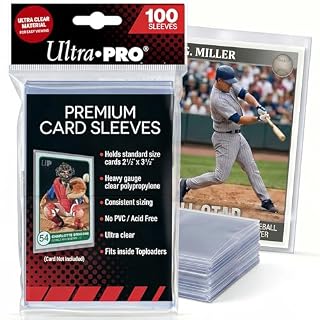
Ultra Pro Premium Clear Card Sleeves, 2.5" x 3.5", 100 Pack | Soft acid-free, non-PVC polypropylene sleeves protect standard Pokémon, MTG, baseball and football cards.
Amazon →