How to Store and Protect Baseball Cards (Sleeves, Toploaders & Beyond)
The complete card protection ladder — when to use penny sleeves, toploaders, one-touch holders, binders, and storage boxes, plus the environmental mistakes that quietly destroy collections.
What This Guide Recommends
The picks referenced below, at a glance — our verdict, current availability, and who each one suits.

Every collector’s first supply purchase

Displaying and protecting premium raw cards

Protecting your collection

Grading submissions and serious shipping
Every collector’s first supply purchase
Displaying and protecting premium raw cards
Protecting your collection
Grading submissions and serious shipping
The Sad Math of Unprotected Cards
Every collector has the story: the childhood shoebox, the rubber-banded stack, the binder left in a hot garage. Condition is half the value equation in this hobby — a card that would grade PSA 9 can lose most of its worth from one soft corner, and corners go soft from a single careless shuffle.
Protection is the cheapest leverage in collecting. A few cents of plastic preserves the premium on a card that might someday be worth hundreds. Here’s the full ladder, from bulk commons to display pieces.
The Protection Ladder
Level 0: Bulk commons — counting boxes
Base cards with no foreseeable value live happily in cardboard counting boxes (400ct, 800ct, 3200ct). Pack them snugly so cards can’t shift, but never so tight you have to force them. No sleeves needed at this tier — the box itself is the protection.
Level 1: Penny sleeves — every card you’d hesitate to throw away
The humble penny sleeve guards against scratches, fingerprints, and surface wear. A 100-count pack of quality sleeves costs less than a single pack of cards and protects a hundred futures.
Technique matters: hold the sleeve open with a gentle squeeze, insert the card bottom-corner first, and let it slide — never push against resistance. Forced entries cause the exact corner dings you’re trying to prevent.
Level 2: Sleeve + toploader — anything worth a few dollars
The rigid toploader stops the bend that kills cards in transit and storage. This combo — penny sleeve inside a toploader — is the hobby’s universal standard for storing, trading, and shipping individual cards. Rookies you believe in, inserts, low-numbered parallels: this tier.
One caution: toploaders are not what grading companies want for submissions — they request semi-rigid holders instead, which are easier to extract cards from safely. If grading is in your future, keep a pack of semi-rigid Card Savers on hand — graders ask for these at submission, not toploaders; our grading guide covers the full submission prep.
Level 3: One-touch magnetic holders — your best raw cards
The Ultra PRO - 35pt Cards UV ONE-TOUCH Magnetic Holder - Premium… is the display standard for premium raw cards: two-piece rigid acrylic, magnetic closure (no screws to crack edges), and UV inhibitors that slow sunlight fade. The 35pt size fits standard cards; thicker patch/memorabilia cards need higher point sizes — see our card size & thickness reference for which point rating fits what before buying.
This is the right home for the rookie cards you’re holding long-term but haven’t sent to grading yet.
Level 4: Binders — for set builders
Building the 2025 Topps flagship set? Side-loading 9-pocket pages in a quality zippered binder are perfect: visible, organized, protected. The rules:
- Side-loading pages only — top-loaders dump cards when the binder tips
- Archival polypropylene, never vintage vinyl (old PVC pages chemically stick to card surfaces)
- Store upright like a library book; stacked-flat binders press card surfaces together
- Don’t overfill — bulging binders bend every card inside
Level 5: Display — show them off safely
Collecting is meant to be seen. A tiered display stand turns slabs and one-touches into shelf art. Two rules keep display from becoming damage:
- No direct sunlight, ever. UV fades ink through windows, through slabs, through everything but UV-filtering glass. Even indirect bright light fades cards over years.
- Rotate displayed cards seasonally if the spot gets any natural light.
The Environment: Where Collections Quietly Die
The protection ladder handles physical damage. Environment handles chemical damage — slower, but irreversible.
| Location | Verdict |
|---|---|
| Interior closet, living space | ✅ Ideal — stable temp and humidity |
| Bedroom shelf, no direct sun | ✅ Fine |
| Finished basement w/ dehumidifier | ⚠️ Acceptable — monitor humidity |
| Unfinished basement | ❌ Humidity spikes = warping, mold |
| Attic | ❌ Heat cycling delaminates and warps |
| Garage | ❌ All of the above plus pests |
| Storage unit (no climate control) | ❌ The collection killer |
Target roughly 65–72°F and 40–50% humidity, but stability beats precision — a constant 75°F is safer than daily swings. A cheap hygrometer in your card closet is cheap peace of mind. In humid climates, toss silica gel packs in storage boxes and recharge them periodically.
Shipping Cards Without Heartbreak
Selling or trading? The standard that survives the postal service:
- Penny sleeve → toploader (tape the toploader’s open end with painter’s tape — easy to remove, no residue)
- Sandwich between two pieces of cardboard, rubber-banded around the cardboard (never the card)
- Bubble mailer minimum; box with padding for anything valuable
- Tracking always; insurance when the card’s worth more than the hassle of a claim
Building Your Starter Protection Kit
For a new collector, the complete kit is modest:
- 100ct penny sleeves — the foundation
- Toploaders (with sleeves) — for the keepers
- Semi-rigid Card Savers — if grading is on your roadmap (graders ask for these at submission, not toploaders)
- A Ultra PRO - 35pt Cards UV ONE-TOUCH Magnetic Holder - Premium… or two — for the card you’d brag about
- A counting box for everything else
That’s the whole system. Every dollar of it protects multiples of itself in preserved value — and if you’re just getting started in the hobby, the Beginner’s Guide covers what to collect in the first place.
Recommended Products for This Guide
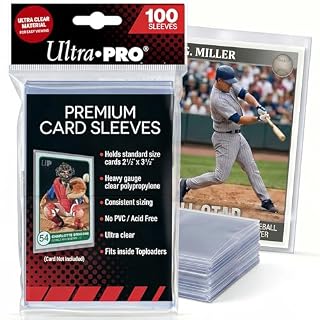
Ultra Pro Premium Clear Card Sleeves, 2.5" x 3.5", 100 Pack | Soft acid-free, non-PVC polypropylene sleeves protect standard Pokémon, MTG, baseball and football cards.
Amazon →

Ultra PRO - 35pt Cards UV ONE-TOUCH Magnetic Holder - Premium Trading Card Display Case, Magnetic Closure, Standard Size Card Protector
Amazon →

Card Sleeves Hard Plastic, Arjiekwei 3"X 4" Trading Card Holder, 35PT | Baseball Cards Protectors for Sports Football Game Cards (200 Hard Sleeves + 200 Soft Sleeves)
Amazon →

Semi Rigid Card Holders & Sleeves for PSA, CGC, BGS & TAG Trading Card Grading Submission
Amazon →